Cette semaine, le journal télévisé de la RTBF (merci TV5Monde), a annoncé dans un reportage que Selah Sue a remporté l'Ultratop Download Award 2011.
Après avoir vu ce reportage, je n'ai pu m'empêcher d'envoyer un commentaire à la RTBF sur la manière dont les journalistes ont présenté l'association entre téléchargements dit "illégaux" et les effets sur l'industrie de la musique et de la vidéo. En voici le contenu :
Bonjour,
Lorsqu'il s'agit de présenter un point de vue sur les downloads de musique, j'aimerais que les journalistes de la RTBF présentent les faits de manière un peu plus objective. En effet, en regardant ce reportage sur Selah Sue, à plusieurs reprises, il est très clair que le concept de téléchargement dit illégal y est directement associé à un effet négatif pour les entreprises d'"entertainment" sans un minimum de sens critique.
Pourtant, certaines études montrent que cet effet est loin d'être garanti, voire contraire, comme le mentionne cet article dans Forbes Magazine : "Does Online Piracy Hurt Entertainment Industry?"
Ou encore certains artistes, comme Paulo Coelho, encourageant le téléchargement illégal parce qu'ils constatent que leurs ventes augmentent avec ceux-ci.
De plus, la MPAA utilise aussi des méthodes qui se situent aux limites de l'éthique ou qui peuvent même être considérées illégales. J'en veux pour exemple, l'utilisation de données économiques largement exagérées, comme le nombre d'emplois touchés par cette industrie. Plus inquiétant, cette menace, proférée par Chris Dodd CEO de la MPAA sur Fox TV, de ne plus signer de chèques aux politiciens si ils ne soutenaient pas la proposition de loi SOPA.
Il parait de plus en plus clair que ce secteur de l'industrie est dépassée et n'arrive pas à actualiser son business model, peut-être à cause des mêmes raisons que celles décrites par Christensen dans son livre "Innovator's Dilemma : When New Technologies Cause Great Firms to Fail". Il est de fait surprenant de voir la MPAA réclamer lorsque, au même moment, Apple annonce des chiffres d'affaires mirobolant dans ce secteur. En effet, iTunes seul, a généré ce dernier trimestre 50% plus de revenu que Yahoo! tout entier!
Le fait que de plus en plus d'acteurs économiques remarquent ces dissonances font que certains d'entre eux voient cette situation comme un champs d'opportunités nouvelles. Par exemple, Paul Graham, Angel Investor reconnu de la Silicon Valley, a écrit un appel intitulé "Kill Hollywood" prenant acte de cette situation et appelant à trouver de "meilleurs moyens de divertir les personnes", je dirais "plus adapté" à notre époque.
Merci de votre lecture.
Saturday, February 4, 2012

Monday, April 18, 2011
Facebook New-Generation Data Center
Facebook has built a new Data Center raising the bar in terms of energy efficiency and operating costs.
Facebook claims this data center is using some of the state-of-the art technologies and designs to reduce energy consumption, be more energy-efficient and so more greeny. Let's take a quick tour of the key characteristics :
- Server design
- 2 types of custom motherboards (AMD & Intel) designed to eliminate every bit of waste (plastic, useless chips) and optimize them for facebook workloads (lot of RAM).
- Chassis is also custom, screw-less and designed to be easy to insert/change elements in it.
- The 450W power supply converts to 12.5VDC and is self-cooled.
- Cooling Design[2]
- air-side economizers : outside air cools inside air (and inside "warm" air is rejected outside).
- Evaporative Cooling : using evaporation of water to cool infrastructure.
- Backup Battery:
- a rack of battery are placed in between 2 triplet racks. These batteries will furnish sufficient energy for both of those triplet racks in case of energy failure.
Facebook claims a PUE of 1.07 (~93% of total energy is used for IT equipment) which seems to be the best in class right now. For a point of comparison, industry average is 1.5 (~66%). And 2 years ago, Google's best data center was operating at 1.12 (~89%) with an average of 1.19 (~84%)[6]. Additionally, Facebook also claims that this design consumes 38% less energy and is 24% less costy than their own current datacenter. Quite impressive!
Altough this new design is good news. There is a better news! Indeed, the actual good news is that Facebook has changed the usual behavior of data centers designers. Currently, there is few data about data centers designs and it is hard to gather data like actual efficiency, failure rates, etc... Facebook made a first (big) step by releasing their design as "open source". So now, people around the world can use those designs, improve upon them and hopefully share these. No IP to worry about! That's a tremendous news! So don't be shy, go read details of the design at Open Compute website!
I can't end this post without a list of questions about the design :
- operating temperature: Some of the state-of-the art data center design are operating around 35°C (95°F). I've heard they're running at 22°C (72°F)[3]
- very low consumption server: although Facebook is talking with ARM.
- Why not using containers i.s.o triple rack? Because Google is the "inventor" of this technique?!? I would not believe it.
- network design?
- Why the hell are they using coal energy as power source? [4]
P.S. : I'm curious to know whether someone already wondered about sound conversion to some other useful energy?!? Indeed, data centers are not sound-free. :)
[1] "Open Compute"
[2] "Open Compute Mechanical System Design", James Hamilton
[4] "Facebook Data Center has Bad Energy", Greenpeace
Thursday, April 7, 2011
Cloud Economics
This was a "quick" answer to another post in my company blog (no, no public access).
My point of view is simple : When considering cloud as a new paradigm, elasticity is a KEY component. Without elasticity, you're just a cloud wannabe.
So speaking strictly of costs, I agree with the affirmation that "Cloud is going from CapEx to OpEx". Though, I would also like to stress the following:
Cloud should allow to decrease the overall of CapEx and OpEx together.
- Decreasing CapEx because of dynamism
You're optimizing your infrastructure resources and so buying less infra (or you're simply leasing it) - Decreasing OpEx because of dynamism & automation
- Costs to add/remove instances, services, etc… are near 0
- Or taking Hamilton's estimates[1], in a very large data center, 1 admin should be able to run >1000 servers alone i.s.o of ~140 in a medium data center.
- It seems that for Google it is around 1 admin per 10.000 servers and they have a goal of 1 admin per 100.000 servers ! [2]
- Decreasing OpEx because of an external service:
Indeed, for customers using a public cloud you get rid of storage mgt, system upgrades, ...
- Elasticity:
- Here is a common strategy to buy hardware in a typical Static Data Center
- evaluate what will be the demand peak
- Buy HW supporting twice this demand
- End with a underutilized infrastructure (typically 10-20% resources usage on average)
- Elasticity enables customers to pay only for what you are really consuming!
- The "pay as you go" business model … because you don't have to overprovision your infrastructure.
- The "pay as you grow" model, for the services growing suddenly, you're able to service the demand as it's growing. While if you had to acquire/install infrastructure, you should have a good capacity planning and having good estimates which is not an obvious task.
- Good to note that Private Cloud Leaders like Google, Amazon & al started to sell their cloud because it enables to amortize their own cloud infrastructure by monetizing their idle time.
- Here is a common strategy to buy hardware in a typical Static Data Center
- Economies of Scale
- Here are costs presented by Hamilton for current typical data centers Resources
- Cost in medium DCCost in Very Large DCRatioNetwork$95 / Mbps / month$13 / Mbps / month7.1xStorage$2.20 / GB / month$0.40 / GB / month5.7xAdmin~140 servers / admin>1000 servers / admin7.1x
- Also, I would like to remember is that it is not a projection. And as engineers, we should also think in terms of what we'll get tomorrow . IOW, the economies of scale will be yet an order of magnitude higher for exascale data centers.
- It means that costs difference between medium and large data centers are between 5-7x ! Huge difference. In the case of Google, some speaks of 100x ! [1, 2]
By considering only these 2 points, it is easy to understand why there is a high probability customers would like to use the cloud to admin their services, even steady one. To name them, because of capacity planning and economies of scale.
Of course, when you want to adopt cloud you have to consider some others characteristics like network bandwidth & storage bottlenecks or some business ones like data confidentiality & auditability, security & vendor lock in.
So when thinking cloud solutions we should always think to the following
- Optimization, Automation, Dynamicity, Resources Synergy, Transparency.
"Pay as You Go" model is something which imposes that you'll bill your customers only what he is actually using. IOW, in the theory, if the CPU of one server is idle, he is not using this server and should not be billed.
"Pay as you Grow" model trends is to have instantaneous elasticity. If the one service grows quickly, the infrastructure grows to attend the peak. If one service demand shrinks, infrastructure adapts itself and shrinks too. Of course, customers costs will vary too growing and shrinking but the idea is to get the infrastructure following the demand.
Lowering Costs:
- Any solution to reduce power/cooling costs is welcome.
- Strong emphasis to automate Administration in order to shift people cost from top costs to nearly irrelevant. Remember: 1admin per 100.000 servers!
No good network automation to date : OpenFlow is one option!
Customer should not even know there are several racks, several CPUs, several layers of caches, etc…
In an ideal world, a customer should be able to buy some resources from a Cloud Provider, install its application/service and running it without thinking to provisioning and capacity planning. That's the first step of Cloud Computing.
I would like to see more! Indeed, a customer should not worry about what is the cloud platform (vendor lock-in) he's running on. Standards APIs (similar to POSIX) should exist in order to have guaranteed interoperability between cloud such that if you want to migrate from one cloud to another, it's just a matter of moving your data. Only by then, we'll get to the Cloud OS.
References:
[1] "Cloud Computing Economies of Scale", James Hamilton
[2] "Cloud Computing: Understanding Economies of Scale, Cloudscaling Blog
[3] "Above the Cloud, Dave Patterson
Internet Maps
Yesterday I saw a new incredible Internet Map (or better infographic) made by Teleography 
After having seen that last map, I thought it might be fun to have a post showing various kind of attempts to creat Internet Map since its start.
My first contacts with Internet Map is quite old since it started in 1999. This map has been made by Cheswick from Bell Labs and he created the Internet Mapping Project (gallery).

Roughly, it shows connectivity between ISPs in the world.
But since then, some other efforts to map the Internet have been made like by Opte

CAIDA is probably the best in its class with great topology representations (Main gallery, Walrus gallery)
One question people might ask themselves is why would we bother about visually representing the internet? Well, there are a lot of bits to that answer. In 2 words, there is no best way to try to understand than by visually stating a problem. It means that we understand better the Internet once it has been graphically represented. Of course, every different representation brings its own bits of interpretation and enables deeper and further understanding.
But also, a graph is nothing more than a mathematical representation and as such CAIDA has been a source of information for researchers worldwide by providing data sets of these representations which helped to think on the Internet represented as a graph (or better as a variety of graphes).
And finally, better understanding or better characterizing Internet structures/behaviors has been the basis for improvements of it.
Note to mention that there are multiple ways to represent the Internet facets.
A first interesting view has been created by World Web Maps. They put web sites on top of the World Map correlating web sites popularity with country sizes.
Facebook made another interesting map. They create a friendship world map showing geographical connection between people.

There had been an effort to create an Atlas of Cyberspaces. This project gathered a lot of maps of all sorts though it seems dead now.
So, to end this post, I guess we should thank people having spent their time to graphically represent the Internet in all of its forms. They all helped getting a better one for today. And in case, you're aware of some other forms of Internet representations I've not mentioned in this post, please share them!

After having seen that last map, I thought it might be fun to have a post showing various kind of attempts to creat Internet Map since its start.
My first contacts with Internet Map is quite old since it started in 1999. This map has been made by Cheswick from Bell Labs and he created the Internet Mapping Project (gallery).
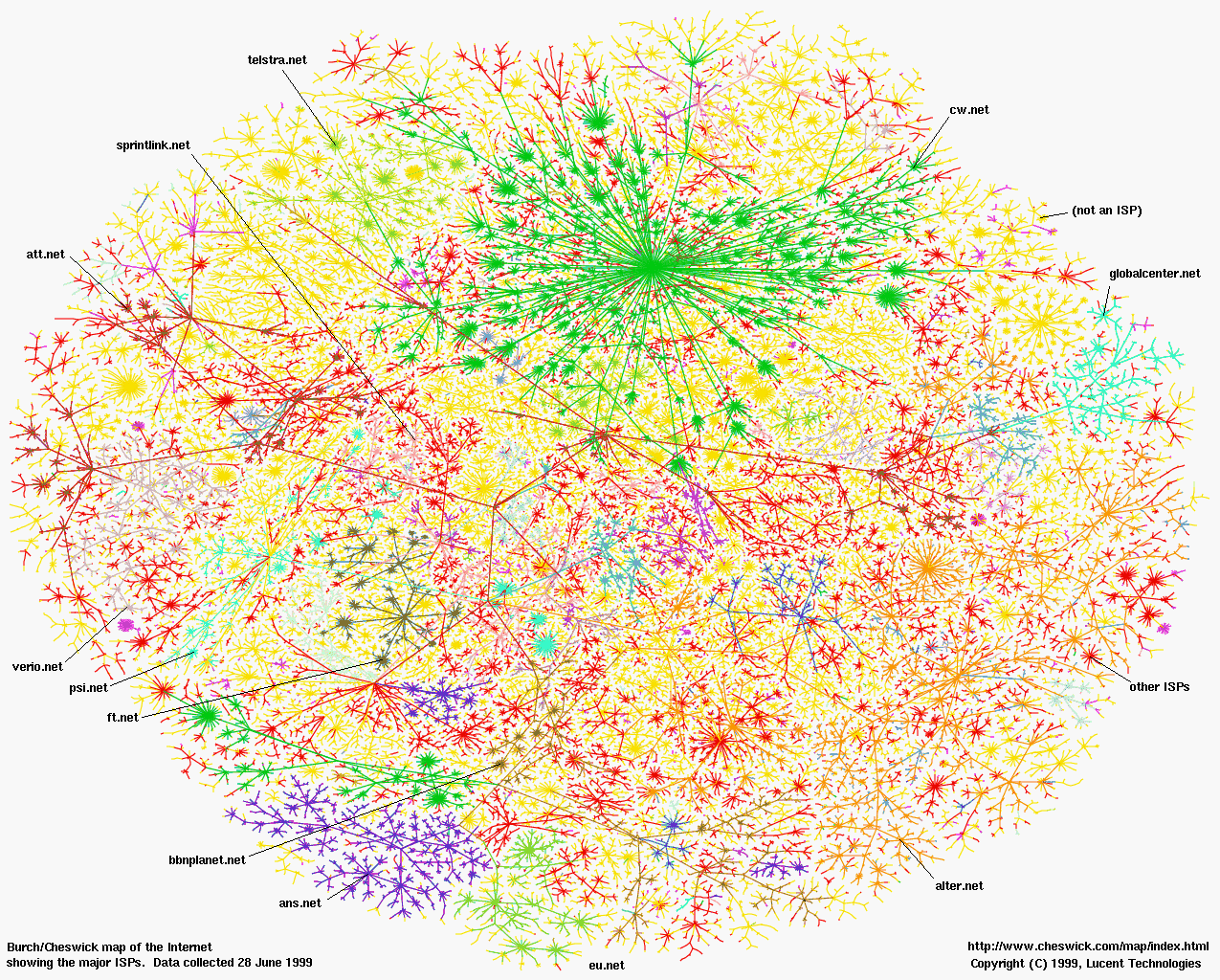
Roughly, it shows connectivity between ISPs in the world.
But since then, some other efforts to map the Internet have been made like by Opte
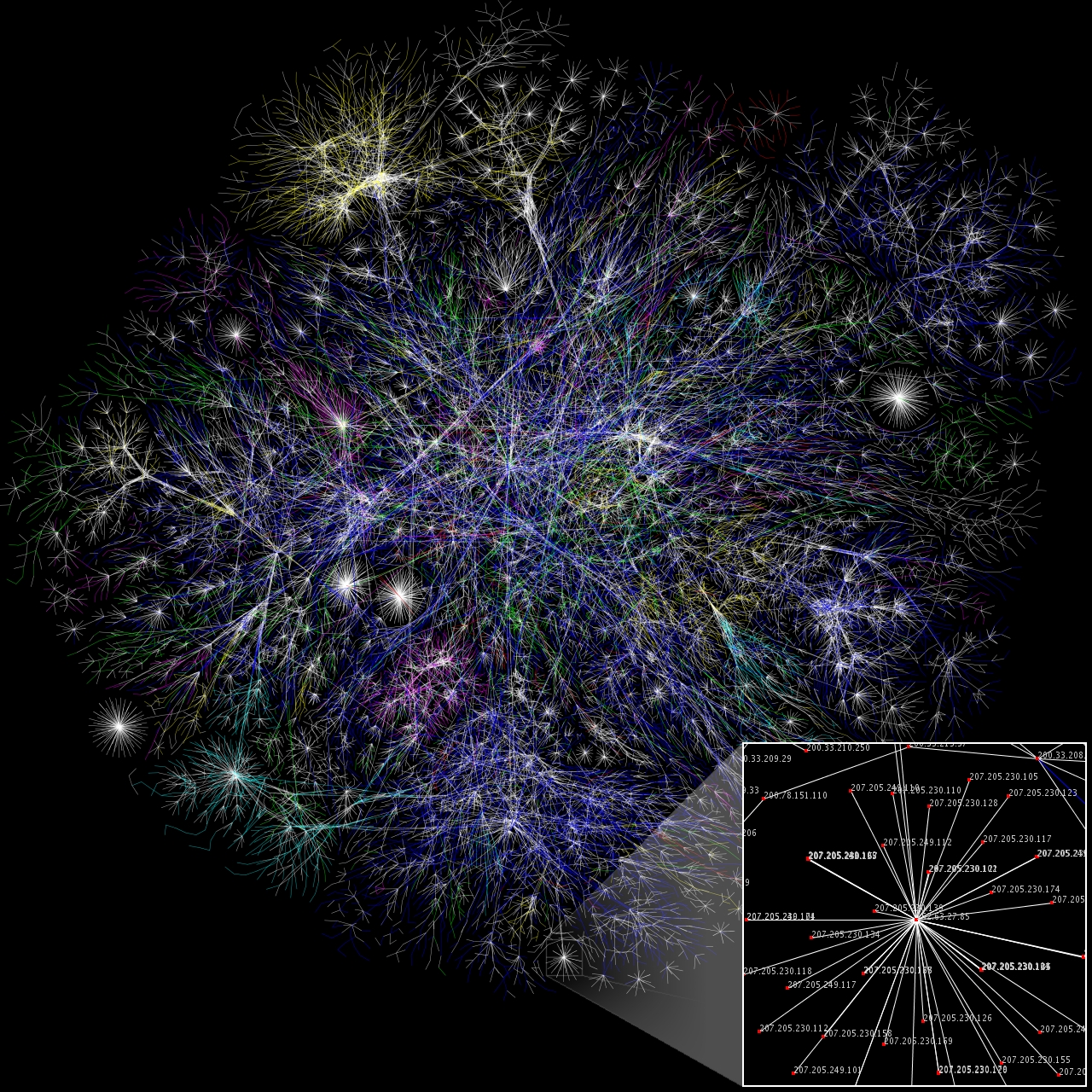
CAIDA is probably the best in its class with great topology representations (Main gallery, Walrus gallery)

One question people might ask themselves is why would we bother about visually representing the internet? Well, there are a lot of bits to that answer. In 2 words, there is no best way to try to understand than by visually stating a problem. It means that we understand better the Internet once it has been graphically represented. Of course, every different representation brings its own bits of interpretation and enables deeper and further understanding.
But also, a graph is nothing more than a mathematical representation and as such CAIDA has been a source of information for researchers worldwide by providing data sets of these representations which helped to think on the Internet represented as a graph (or better as a variety of graphes).
And finally, better understanding or better characterizing Internet structures/behaviors has been the basis for improvements of it.
Note to mention that there are multiple ways to represent the Internet facets.
A first interesting view has been created by World Web Maps. They put web sites on top of the World Map correlating web sites popularity with country sizes.
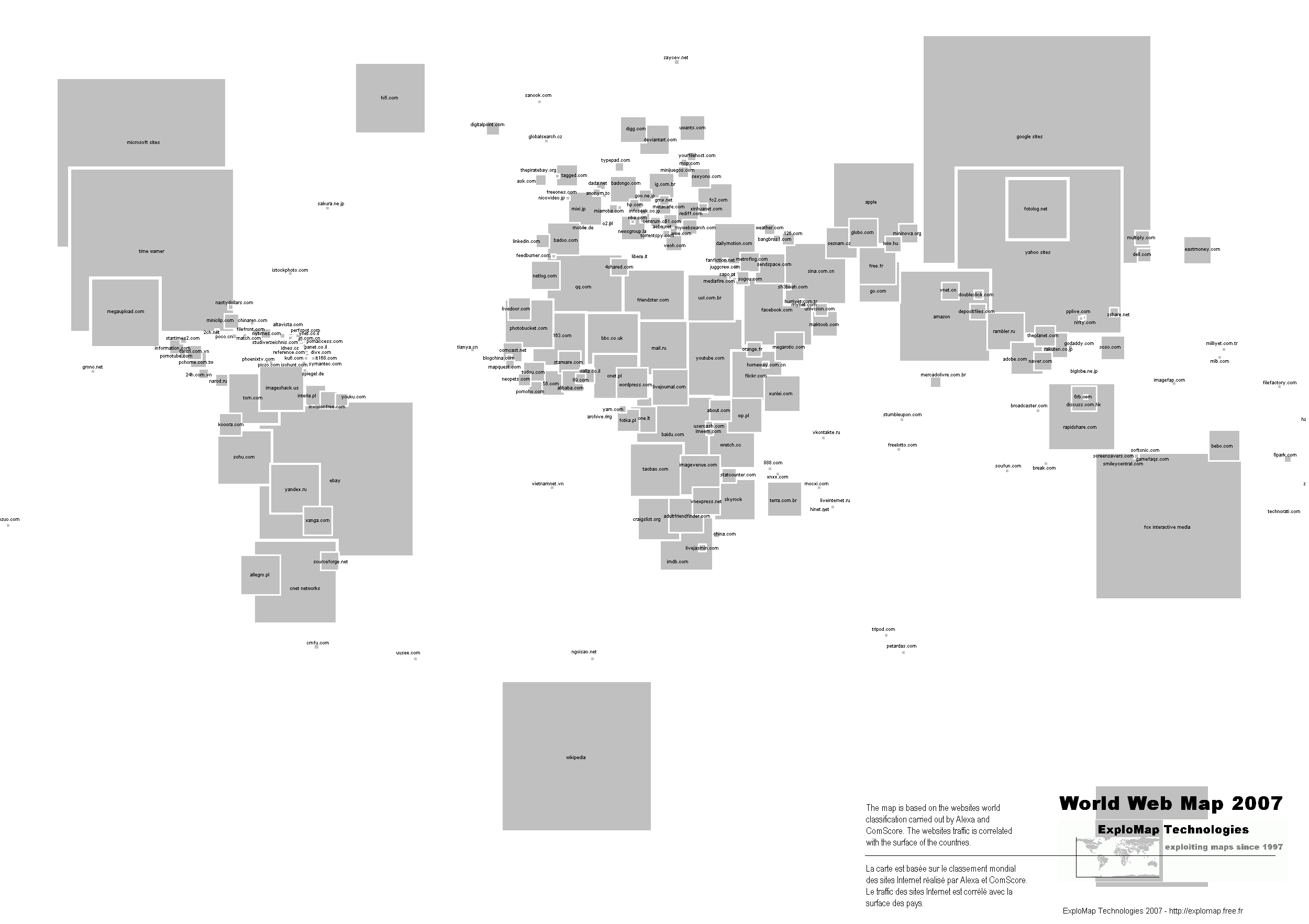
Facebook made another interesting map. They create a friendship world map showing geographical connection between people.

There had been an effort to create an Atlas of Cyberspaces. This project gathered a lot of maps of all sorts though it seems dead now.
So, to end this post, I guess we should thank people having spent their time to graphically represent the Internet in all of its forms. They all helped getting a better one for today. And in case, you're aware of some other forms of Internet representations I've not mentioned in this post, please share them!
Wednesday, April 21, 2010
A Call to Unity and Difference Equity
Taking a look at the human development index, Belgium is a good country to live in. In 2007, we were in a better position than 91.3% of the rest of the world. Even if our position has already been better, there is nothing we could complain about. Does it capture all our reality? Of course not. For the one who knows about our political situation, it is obvious that this index - which is barely a statistical tool based on some selected criteria - is loosing some information like political stability and/or discrimination mechanisms, whatever they be positive or negative. I'm ashamed, terrified and bewildered to see how much time politicians can spend to stigmatize some differences or minor facts instead of worrying about major issues of our society. And when I mention "our society", I really mean, by order, the World, then Europe and finally Belgium. While most of us agree, the world is now global, some - politicians included - forget to change their priorities and point of views to be able to govern sanely!
That's because of such a disappointment of our political tool that I decided to wrote a letter to almost all belgian media. I hope that this one won't be only a message in a bottle. Here is a transcription of it (French version, Flemish Version) :
Belgium, country where I happily grew up, born in Bruxelles from a mother of flemish origin and a walloon father. Belgium, having "Strength Through Unity" as its motto. Belgium, internationally recognized as the heart of Europe, representing the greatest adventure of international unification of History. Belgium, country of surrealism! While some are globally unifying themselves, others are locally quarreling, pushing to an unbelievable separation. Unbelievable?! No! Surrealist! The Heart of Europe split in two! Even Magritte had not thought about it : "This is not Belgium".
If Magritte invite us to the hypersensibility, I shall remember, it is just purely theoretic. Gentlemen politicians, it is yours, and not only to the King, to keep the unity of our Belgium we have entrusted to you. Universal suffrage is not a toy you can use and abuse without sanctions. You are responsible for this virtual border that has gradually turned unavoidable, representative of a symbolic segregation of some differences in our nation. Today, this segregation becomes more and more concrete. The announcement of this scheduled discrepancy by some lead us in a no through road. Surrealism is an entertaining mind game, it is not and never will be a political solution!
As in any conflict, the solution primarily lies in understanding each other. Nothing is more destructive nor negative that withdrawal and ignorance or rejection of the other. In our arsenal? An infinite number of actions, symbols of tolerance, understanding and cooperation, all we can execute in our everyday life to demonstrate that we did not yet come at a surreal impasse that some would like us to follow and that there is another path.
So today, I invite to cooperation of all national and regional media, Flemish and Walloon, to take a step toward understanding of each other, releasing a regular and at the same day - as a symbol of our union - a topic related to the "other region" and translated in both languages, symbols of the acceptance of the differences of our nation. Hoping that one day, this won't no longer be considered a subject related to the "other region" but as a topic on our united country! And yes, when that day comes, we will happily exclaim "This is not a region!".
Belgium, country where I happily grew up, born in Bruxelles from a mother of flemish origin and a walloon father. Belgium, having "Strength Through Unity" as its motto. Belgium, internationally recognized as the heart of Europe, representing the greatest adventure of international unification of History. Belgium, country of surrealism! While some are globally unifying themselves, others are locally quarreling, pushing to an unbelievable separation. Unbelievable?! No! Surrealist! The Heart of Europe split in two! Even Magritte had not thought about it : "This is not Belgium".
If Magritte invite us to the hypersensibility, I shall remember, it is just purely theoretic. Gentlemen politicians, it is yours, and not only to the King, to keep the unity of our Belgium we have entrusted to you. Universal suffrage is not a toy you can use and abuse without sanctions. You are responsible for this virtual border that has gradually turned unavoidable, representative of a symbolic segregation of some differences in our nation. Today, this segregation becomes more and more concrete. The announcement of this scheduled discrepancy by some lead us in a no through road. Surrealism is an entertaining mind game, it is not and never will be a political solution!
As in any conflict, the solution primarily lies in understanding each other. Nothing is more destructive nor negative that withdrawal and ignorance or rejection of the other. In our arsenal? An infinite number of actions, symbols of tolerance, understanding and cooperation, all we can execute in our everyday life to demonstrate that we did not yet come at a surreal impasse that some would like us to follow and that there is another path.
So today, I invite to cooperation of all national and regional media, Flemish and Walloon, to take a step toward understanding of each other, releasing a regular and at the same day - as a symbol of our union - a topic related to the "other region" and translated in both languages, symbols of the acceptance of the differences of our nation. Hoping that one day, this won't no longer be considered a subject related to the "other region" but as a topic on our united country! And yes, when that day comes, we will happily exclaim "This is not a region!".
Kind Regards
Een oproep tot eenheid en verdraagzaamheid omtrent verschillen
België, land waar ik het geluk had te zijn opgegroeid, geboren uit een moeder met vlaamse voorouders en een franstalige vader. België, die “Eendracht maakt macht” als leus heeft. België, internationaal erkend als hart van Europa, vertegenwoordigster van het grootste avontuur van internationale eenheid uit de geschiedenis. België, land van surrealisme ! Terwijl men zich enerzijds totaal verenigd, gaan de anderen lokaal gaan ruzie maken en een onbegrijpelijke scheiding gaan doordrukken. Onbegrijpelijk?! Neen! Surrealistisch ! Het Hart van Europa in twee gesplitst ! Zelfs Magritte had er niet aan gedacht : “Dit hier is geen België.”
Indien Magritte ons uitnodigt tot overgevoeligheid, moet ik eraan herinneren, dat dit slechts iets theoretisch is. Heren politici, het is aan u, en niet aan de koning alleen, om de eenheid te bewaren van ons België dat wij u toevertrouwd hebben. Het algemeen kiesrecht is geen speelgoed waar u zonder sancties kunt van gebruik maken of misbruiken. U bent verantwoordelijk voor deze virtuele grens die beetje bij beetje een onvermijdelijke wending heeft genomen, vertegenwoordigster van een symbolische scheiding van de verschillen van onze natie. Heden ten dage wordt deze scheiding telkens concreter. Het verkondigen van dit door sommigen geprogrammeerde gebrek aan overeenstemming leidt ons alleen naar een doodlopende weg. Het surrealisme is een spel van de vermakelijke geest. Het biedt geen, en zal ook nooit een politieke oplossing bieden!
Zoals bij elk conflict ligt de oplossing hoofdzakelijk in het begrijpen van de andere. Niets is meer negatief noch meer destructief als het in zichzelf gekeerd zijn en de onwetendheid of het verwerpen van de andere aan zijn zijde. Ons arsenaal? Een oneindig aantal acties, symbolen van verdraagzaamheid en begrip, die wij dagelijks kunnen realiseren om aan te tonen dat wij nog niet terecht gekomen zijn in de surrealistische patstelling die ons wordt voorgeschreven maar dat er een andere uitweg bestaat.
Het is daarom, vandaag, dat ik de medewerking vraag aan alle nederlandstalige en franstalige nationale of regionale media, om een stap te zetten naar het begrijpen van de andere, door het regelmatig en allen op dezelfde dag – als symbool van onze eendracht – een onderwerp in verband met de “andere regio” te publiceren, vertaald in beide talen, symbool van aanvaarding van de verschillen in onze natie. Hopend dat een dag dit niet meer zal gezien worden als een onderwerp dat alleen de “andere regio” aanbelangt maar als een onderwerp over ons verenigd land! En ja, dan, die dag gekomen, zullen we vrolijk kunnen uitroepen “Dit hier is geen regio!”
Vriendelijke groeten.
Un Appel à l'Unité et l'Equité des Différences
Selon l'indice de dévelopement humain, la Belgique est un pays où il fait bon-vivre. En 2007, nous étions en meilleure position que 91,3% du reste de la planète. Même si notre position a déjà été meilleure, nous n'avons vraiment pas de quoi nous plaindre. Cela capture-t-il toute notre réalité? Il est évident que non. Pour celui qui connait la situation politique en Belgique, il est clair que cet indice - qui est un outil statistique se basant sur quelques critères sélectionnés - perd quelques informations notamment, stabilité politique et/ou mécanismes de discriminations, qu'elles soient positives ou négatives. Je suis honteux, terrifié et abasourdi de constater ô combien nos hommes politiques peuvent passer de temps à se tendre des embuches les uns les autres et stigmatiser certaines différences ou faits mineurs au lieu de s'occuper des problèmes majeurs de notre société. Et lorsque je fais mention à "notre société", je parle en ordre de priorité du Monde, ensuite de l'Europe et, finalement, de la Belgique. Alors que tout le monde s'accorde à dire que le monde s'est globalisé, certains - hommes politiques inclus - oublient de changer leur priorité et angle de vue pour pouvoir gouverner sainement!
C'est parce que j'ai une telle déception de notre organe politique, que j'ai décidé d'écrire une lettre au "courrier des lecteurs" de la majorité des médias belges. J'espère sincèrement que celle-ci ne sera pas qu'une bouteille jetée à la mer. En voici la retranscription (Nederlands versie, English Version):
Belgique, pays où j'ai grandi avec bonheur, né à Bruxelles d'une mère d'origine flamande et d'un père francophone. Belgique, ayant comme devise "L'union fait la force". Belgique, internationalement reconnue pour être le coeur de l'Europe, représentante de la plus grande aventure d'unité internationale de l'Histoire. Belgique, pays du surréalisme! Alors que les uns s'unissent globalement, les autres se querellent localement poussant à une séparation incompréhensible. Incompréhensible?! Non! Surréaliste! Le Coeur de l'Europe séparé en deux! Même Magritte n'y avait pas pensé : "Ceci n'est pas une Belgique."
C'est parce que j'ai une telle déception de notre organe politique, que j'ai décidé d'écrire une lettre au "courrier des lecteurs" de la majorité des médias belges. J'espère sincèrement que celle-ci ne sera pas qu'une bouteille jetée à la mer. En voici la retranscription (Nederlands versie, English Version):
Belgique, pays où j'ai grandi avec bonheur, né à Bruxelles d'une mère d'origine flamande et d'un père francophone. Belgique, ayant comme devise "L'union fait la force". Belgique, internationalement reconnue pour être le coeur de l'Europe, représentante de la plus grande aventure d'unité internationale de l'Histoire. Belgique, pays du surréalisme! Alors que les uns s'unissent globalement, les autres se querellent localement poussant à une séparation incompréhensible. Incompréhensible?! Non! Surréaliste! Le Coeur de l'Europe séparé en deux! Même Magritte n'y avait pas pensé : "Ceci n'est pas une Belgique."
Si Magritte nous invite à l'hypersensibilité, dois-je le rappeler, ceci n'est qu'une vue de l'esprit! Messieurs les hommes politiques, il est à vous, et non au Roi seul, de garder l'unité de notre Belgique que nous vous avons confiée. Le suffrage universel n'est pas un jouet dont vous pouvez disposer et abuser sans sanctions. Vous êtes responsables de cette frontière virtuelle qui peu à peu s'est vue incontournable, représentante d'une ségrégation symbolique des différences de notre nation. Aujourd'hui, cette ségrégation devient à chaque fois plus concrète. L'annonce de cette discordance programmée par certains nous mène dans une voie qui ne peut être que sans issue. Le surréalisme est un jeu de l'esprit divertissant, il n'est pas et ne sera jamais une solution politique!
Comme lors de tout conflit, la solution réside principalement dans la compréhension de l'autre. Rien n'est plus négatif ni destructif que le repli sur soi et l'ignorance ou le rejet de l'autre à ses côtés. Dans notre arsenal? Une infinité d'actions, symboles de tolérance, de compréhension et de coopération que tous nous pouvons exécuter au quotidien pour démontrer que nous ne sommes pas encore entrés dans l'impasse surréaliste qu'il nous est donné de suivre et qu'il existe un autre chemin.
C'est pourquoi, aujourd'hui, j'invite à la collaboration de tous les médias nationaux ou régionaux, flamands et francophones, à faire un pas vers la compréhension de l'autre, en publiant de manière régulière et tous le même jour - symbole de notre union - un sujet en relation à "l'autre région" et traduit dans les deux langues, symboles de l'acceptation des différences de notre nation. En espérant qu'un jour, ce ne soit plus considéré comme un sujet touchant à "l'autre région" mais comme un sujet sur notre pays uni! Et oui, alors, ce jour venu, nous pourrons nous écrier gaiement "Ceci n'est pas une région!".
Bien à vous.
Tuesday, April 20, 2010
An Economy Of Liars
Reading the article "An Economy of Liars" in the Wall Street Journal, I've been surprised by the fine analysis made by Gerald P. O'Driscoll Jr.
He's telling us that we're in a crony capitalism because government and business collude. Wow, what a surprise to hear that from someone having worked as VP of Citigroup and VP at the Federal Reserve Bank of Dallas, isn't it? He argues that indeed Congress is charmed by lobbyists, experts backed by the industry, and so on... Plus, it seems that the regulators failed to see the obvious (Madoff and others). I would then wonder why this occured, but he's not really answering this point. He concludes that this scheme would be closer to Benito Mussolini than Adam Smith.
He then continues by a theoretical vision of how that should work (price system as information-transmission mechanism, honest pricing, ...) based on "Nobel laureate" Hayek's research. He states that communism failed because it did not rely on prices to allocate resources and that - roughly - this crisis could have been caused by the government because it controls 90% of housing finance. WTF?! Wow! Well done! Government is the bad guy having created the crisis because of some of their policies. That's a beautiful one! It means government is the culprit because some banks have created and sold toxic assets!
The conclusion is that we should return to free market by restoring truth-telling on markets. Of course! I'm ready! What a perfect world! Uh! But, just wait a minute ... Who was lying to us? Government? Who has created these toxic assets? WTF, Gerald! You therefore are continuing to lie to us?! I can't believe it ...
I have some questions for Gerald. Could you tell me why these lobbyists or experts exist? Or more accurately, what are the reasons behind their existence? What would your vision of the world change? Would it mean that if we were in your free market vision of the world, institutions would stop to cheat? Really?! Are you *really* selling us this idea? I mean ... *really, really*?
My man, you're just asking the wrong question! You can't rely on a perfect theory nor a perfect world. In practice, theory models are not correct and world is not simple! The answer is not to tell us that financial won't never fail within this framework or another. They will fail! We are human! Then the real question to answer is "What are our best mechanisms to handle these financial institutions when they (will) come to fail?" Followed by an addendum describing "how smart these mechanisms are" and "what are their limits". Again, when governments are creating some laws telling humans they can't kill someone, they are also creating some institutions being able to catch/investigate the potential infringing cases. These are far from being perfect but who would tell seriously they should not exist?
I agree with you, bailing out these financial institutions should not have been done! This is the natural selection. But what consequences then? Tell me.
More, sanctions should not be something theoretic! Whatever the situation in which you are, people are infringing some rules - whatever they be laws or morale. If free market for you means that there is no way to sue some financial institutions, I would not like to live in the same world. Financial Institutions are already cheating with some regulations, imagine what mess it would be if they were no rule at all for them! Who is fool enough to let the world without any regulations? (to the exception of the ones who are already cheating right now of course ...)
Would free market solve the climate issue? Unemployment? Water? Oil price? Or US wealth distribution?
Saturday, April 17, 2010
Driving a Car in Porto Alegre is an Art
One thing you should know about driving in Porto Alegre is that roads belong to people, like if it was their kingdom. One different kingdom for each one on the road. It seems to have some kind of feudal rules applying and others present on the roads are seen like the villein.
What does that mean in practice?! For example, Friday morning, I was on the road guessing that I could, in my own right, continue straight my way, although suddenly one of these lords appeared from a road on the left and entered into this 3-way road like a missile and almost threw me away of the road. Fortunately enough, I was not checking the radio nor reading my emails on my iPhone nor twitting something and I've brake enough to avoid an embarrassing situation. I admit, I've tried to - as gently as I could at that time - tell the driver how I've been disappointed by his behavior. You know, the kind of names I can't mention here because I've not asked if you are above 18 years ... When I told you here above, that it seems that some feudal rules applies in Porto Alegre, it is because these kind of guys are not trying to excuse themselves. Why would they? They are the lords! And what is doing a lord with their villeins? Oh yeah, they're just telling them how much the villein was wrong and next time, they'll do exactly the same way!
Oh, I already see some telling me : "C'me on, it happens from time to time!" Of course, it might! Although, words do not relate the story so well as reality and the way it happened should already be a sign of complete inaptitude to drive a car but ... Problem is that these lords are everywhere in Porto Alegre. I could have mentioned tenths of these stories where one lord is driving like a ... lord! And who will tell you how you, the villein, should have driven to let him reign on his kingdom quietly!
That's why, in Porto Alegre, it's an art of driving a car. Not the art of driving but the art of Zen. Indeed, you have to open your mind, meditate a bit, relax and above all, take a deep dive into philosophy of life.
Thursday, April 15, 2010
My goal is already not sufficiently challenging anymore!
2010, year of all the challenges. I decided that, as I'm seriously thinking to build some kind of cloud, I would build one of around 100.000 servers. A challenging goal, isn't it? Well, at the time, I thought Google had 450.000 servers. Already lost a bit of sex appeal, isn't it? Though, it was yet a real challenge for ... a first step!
Well, after having read this, I have to admit it would be better to review my goal! Indeed Google probably owns more than 1.000.000 servers which is around 2% of all world servers. Gosh! My goal seems so ridiculous now!
What about having 1% of all world servers in let's say, 5-10 years! That's challenging, isn't it?
What a good S.M.A.R.T. goal! I've some doubt about the R meaning though ... hmm!
Wednesday, April 7, 2010
About US Diplomacy (In-)Efficiency
A quick reaction on an another article in Newsweek, "Leaning on Lula", from James P. Rubin, who is "an adjunct professor at Columbia University's School of International and Public Affairs and an informal foreign policy advisor to U.S. Secretary of State Hillary Clinton and President Barack Obama. Having served in the State Department during the administration of President Bill Clinton, he became a Sky News television news journalist."
This article, way better than the one from Stefan Theil, is defending - in a very rough summary - the following thesis : if "International Atomic Energy Agency [which] made clear in its most recent report that Tehran still refuses to suspend its nuclear enrichment programs [...] and notes that there are substantial grounds to believe that Iran's program is intended to build a nuclear weapon" then "countries like Turkey and Brazil [...] should respond when a U.N. agency issues such a report."
Mr Rubin then continues with "if countries like Brazil want to play a more prominent role, then they have to shoulder the responsibility of upholding those rules. When the IAEA declares Iran is flouting those rules, responsible countries must respond and punish the rule breakers."
Seems obvious, isn't it? Though, I would say "What you have to understand is that there is a real world and an ideal world.", isn't it Mr Rubin?
Of course from an ideal point of view, one might think such an argument could not be clearer and fair. Meanwhile, I would like to make people think about something.
We are living in a world of diversity. It has been thought for a long time capitalism and globalization would expand occidental values like democracy and liberalism to the rest of the world. It appears to be a naive view of how nations are reacting/behaving and negating identity differences from each other. A more real picture would be that each nation has its own culture and because of this, its own idea of how politics and commerce should be run whatever it be democratic or not and/or liberal or not.
BRIC is growing fast and raising their voices each time a bit more. Brazil, 10th economical power in the world, made it clear he wanted to be a permanent member of the U.N. Security Council. From these two points, you can deduce that Brazil has its own view on how the world should be run and they would like to show how it could be done. Probably even more after Brazil easily overcome the global crisis despite the international specialists telling them they would be hit severely by the second wave like in a tsunami.
Of course, from an ideal point of view, the argumentation of Mr Rubin seems to be clear and fair. Indeed, if the IAEA responsible to warn U.N. who is wrong in every subject related to nuclear arsenal, then Brazil should listen to it without saying a word. However, it is without taking into account this new necessity to show the world how powerful they could be and even more without taking into account some details of what USA has done these last years.
Indeed, these last years USA has shown several times that he is going alone against International Community. At the U.N. Security Council, it has vetoed a lot more resolutions than any other 4 countries and last time they went to war against Iraq, it was also against what International Community was wishing with some slogans like, "you're with us or you're against us". Worst, it appears they lied and few are really convinced now - I hope none - it was a war against WMD. Guantánamo is of course, by no means a better picture of what USA is capable of. These kind of actions, taken into their context, is of course just throwing discredit to any US diplomat/journalist desiring now to give a lesson of how others countries should react when U.N. reports something. And it appears to me that at a first sight, the article could appear to be fair. But, in fact, I've been in a position of rejecting the whole idea because of these actions taken by USA these last years. And unfortunately for the US diplomacy/journalism, I fear that I'm not alone and that there is probably no quick heal to this situation.
At last, Mr Rubin concludes with "Sometimes even friendly countries must understand that they will pay a price for defying the United States."
The conclusion Mr Robin is so clumsy. This last sentence is just showing the world how USA is aggressive when it comes to disagree with them. Why again playing the pitbull and remember to everyone that USA policy can be "you're with us or against us"? Besides of probably not being the most efficient way of negotiating something, I fear that this kind of strategy is not the one which will accelerate the healing process.
Monday, April 5, 2010
Europe attacking capitalism? Best joke of the year!
This week I read an article in the Newsweek from Stefan Theil, "The No-Growth Fantasy : Europe's attack on capitalism".
The thesis of the whole article is that because of some circumstances (worst economic crisis in 60 years, apocalyptic warnings of climate change and erosion of West's predominance) you get some "radical new ideas" - though not so new - and being stamped by the author as no-growther's one. He then spend the rest of the article to demonstrate these ideas make no sense and are the wrong path to take ("no-growth fantasy") or that's even an "attack on capitalism".
Let's take a look at what he tries to show/demonstrate.
First, to clarify, it is not because ideas are not new they are wrong. Like I already wrote in another post, historically, most of radical new political ideas took a long time - sometimes even more than 100 years - to reach a mature state and be well accepted by the population. By default, people - whatever they be politics or journalists - don't accept easily radical new ideas because it changes their comfort zone.
The background of the article is a rough summary of 3 "new" ideas, Britain and French political ones and a German book. Without agreeing with them, I would at least recognize that some people think about valid and serious issues and if I had to negate the correctness of these solutions, I would well prepare my arguments.
He admits these issues raised are valid like growth financed by unsustainable bubbles, resource depletion (food, oil) - so easy and basic questions to solve, right? - and GDP as a valid measure of human progress. For which latter, he admits there are not much more economists thinking GDP is a valid measure of the progress but on the other hand it has obviously not reached all the layers of the society otherwise it would not be an issue raised today, correct? Well, OK. We only stick with 2 issues out of 3 'cause the French idea makes sense since even "economists are the first to admit that GDP is at best a proxy for prosperity, not an end in itself". Why having taking time to mention French then?
He starts however his argumentation with a somewhat poor relation between these new ideas and predictions made by people (Thomas Malthus or Club of Rome) about some issues which have not occurred within the timeframe they warned it could occur. I don't understand why using this as an argument to demonstrate that the new ideas would be wrong because some other predictions have not occurred. It makes almost no sense. Even less when you know that the issuess raised by these predictions are still hanging out above our heads today!
When he comes to potential solutions, he simply mentions two points :
- these "no-growthers" would not take sufficiently into account technical evolution, environmental regulation, greater efficiency and behavioral change. What I would like to emphasize here is that if nobody is raising an issue, nothing will ever be done to try to change the situation. Plus, the issues we're talking about requires political regulations and time. These are not the kind of issues one can change alone, nor be solved from one day to another without any cooperation between nations. A good example is the Copenhagen conference for which results have been a global disappointment.
- Genetic engineering has also been mentioned. Well, yes, genetic engineering could help humankind to feed itself. Though, 'til now Monsanto has not convinced me it helped humanity in any way. But one day it might and I do bet it will be because some governments will regulate the way they'll have to do their job.
IOW, some unfounded criticism but no proposal of concrete solution for bubbles or resource depletion. Well, ok, let's continue maybe there are some later.
Next paragraph is probably my favorite. I learned that French president Nicolas Sarkozy would lead a european marxist movement. Would you expose that idea to any european that he could think you're trying to launch a new kind of one man show comedy. No, Stefan, seriously! I hope you're joking when you're trying to bind Sarkozy and Marxism in the same sentence, don't you? Oh but wait a minute, why do we speak about French again? Don't we have let them out of the game since they were right about the GDP? Oh nooo, Stefan is a man of suspense and surprise. Indeed, French people would be indoctrinated by a schoolbook because containing the sentence "economic growth imposes a hectic form of life that produces overwork, stress, nervous depression, cardiovascular disease, and cancer". Do you know how many students have read this schoolbook? It should be near from zero. Reading this kind of argumentation from someone writing articles in Newsweek is so disappointing. I really think it's at the same level of what has been related by Fox News about "indoctrination" of some children at school because they were "singing praises of President Obama".
He also raised an interesting affirmation which could be formulated like : "Do you really think this now famous sentence in French schoolbook about economic growth would not sound crazy to these 2.6 billion people living with less than US$2 per day?' Well, I'm living in Brazil for 3 years now and I have worked in some its slums, I know by experience, that people there are much closer to Marxist ideas than capitalist ones because they're living in a country with one of the highest GDP in the world though they're not seeing any practical improvements for them. Plus, helping one each other is something natural in their situations and nowadays, helping one each other is something closer to communism, right? :) Brazil is unfortunately a country where wealth redistribution is not working well. iow, capitalism promises are not working the way theory told us. To continue at the same level, I know people from Eastern European countries who would like to get back to communism era because their situations were better back then. Does that mean these people are right? Not sure. What I'm sure about is that it's not much more valid argument than the one from Stefan telling that because 2.6 billion of poor people might think economic growth might be positive for them that by induction the idea of capitalism can then not be improved. It's a lot of unfounded "might" to try to convince us that one idea could not be improved.
Whether the Britain or French government or the German book are right about the solutions they would put in place, I don't know. What I'm sure about is that they would not try to put in place a "no-growth" solution. If you're seriously believing it, you're completely missing the point. These 2 states because of some bad situations, created by faulty capitalist institutions and because economic development is limited, are trying to find out mechanisms to improve our system by defining some regulations - within capitalist framework - in order to reach a growth with sustainability and stability in mind! Selling us France and Britain are attacking capitalism?! Com'on Stefan! Who is foolish enough to buy that idea?!
I've not read Benjamin Friedman's book, "Moral Consequences of Economic Growth " and I don't know if it's because the article's author oversimplifies his ideas but it does not take me 1 minute to know that economic growth is not equal to unlimited resources nor of intolerance and populism disappearance. Take a look at what happens in the USA right now with the health coverage system reform. Do you think that some of the well-educated Republicans are acting like if they were tolerant and not populist? Let me laugh (or in fact cry) once again. I would like to be in a world where people are tolerant and not populist, it seems we currently are not and it is independent from having growth or not.
I've not read Benjamin Friedman's book, "Moral Consequences of Economic Growth
" and I don't know if it's because the article's author oversimplifies his ideas but it does not take me 1 minute to know that economic growth is not equal to unlimited resources nor of intolerance and populism disappearance. Take a look at what happens in the USA right now with the health coverage system reform. Do you think that some of the well-educated Republicans are acting like if they were tolerant and not populist? Let me laugh (or in fact cry) once again. I would like to be in a world where people are tolerant and not populist, it seems we currently are not and it is independent from having growth or not.BTW, while we're speaking about USA. I would not be surprised the author thinks USA is a good example of how capitalism should be driven. At least, "Europe Philosophy of Failure" let me guess it. The question is then : "Would I be proud to sell the benefits of economic growth of a country which has the highest rate of poor people of all developed country?". I won't even speak about health coverage system, I might be stamped of communist! I don't think it is really something faulty for others countries to have 1) their specificities because world is about diversity and 2) trying to avoid to make the same mistake others could make. Does that mean these countries are perfect? Of course not, nobody is and everybody should constantly learn from mistakes. Some should learn about humility.
Conclusion : not a clue of a solution about unsustainable bubbles, not even about rate of resource depletion, poor argumentation, generalization or statements coming from nowhere. Everything to make a "good" article. I do prefer and by large reading some articles with well built argumentation from Le Monde Diplomatique (also Stefan preference, right?) than that kind of article which just tries to demonstrate something so badly and without exposing decent arguments. Stefan, tell me if you need some contacts to program your next one man show. I would be your first fan!
Thursday, April 1, 2010
A Tweet on "Success"
I've read a tweet today which got my attention : "Sucesso? Entregue rápido e de forma frequente, receba feedback contínuo, mude a direção conforme a necessidade.E seja transparente."
An English version : "Success? Release quickly and frequently, receive continuously feedbacks, change the direction following the needs. And be transparent."
I know smart and experimented people will understand this sentence the right way. However, they probably already know these concepts. I then take as hypothesis that writing this sentence on Twitter has a purpose mainly for people not knowing it. In this case, I feel uncomfortable in the sense this sentence might be misinterpreted in so many ways. I would like then to clarify some implicit concepts behind the ones in the sentence :
- Release quickly and frequently :
- you then adhere to incremental methodologies (like agile ones ... you don't?).
- quickly :
- does not mean that you should release something which does not bring anything valuable.
- advantage it allows you to receive feedbacks sooner
- frequently :
- does not mean releases are mandatory.
- It means that you should release any added value stuffs of what you're working on frequently (time-to-market, feedbacks sap)
- corollary, don't try to release frequently any bullshit ... it is just waste of time, money, etc...
- added value is something which already answers some needs (see next point on following needs)
- receive continuously feedbacks means
- exists at least one way to receive feedbacks (or if it is possible, asking for them pro-actively)
- you take really these feedbacks into account
- you take actions
- change the direction following the needs
- means you know how to explicitly identify the needs at their roots!
- for instance, for customers you need to measure what they need.
- Avoid try to feel what they might like. Prefer being a scientist and discover/measure what are their needs.
- Avoid trying to artificially create some need and pushing it to them!
- Be transparent : from the communication, value and morale point of views.
Of course, all this could not be written in 140 characters ... but I thought it deserves a small post. (thoug this post is not meant to be exhaustive neither.)
Subscribe to:
Posts (Atom)